Understand the code. Apply it in context.

Code Workspace turns complex building-code provisions into practical guidance, connected references and visual explanations grounded in the source.
blinkode.ca/app/OBCCode Workspace
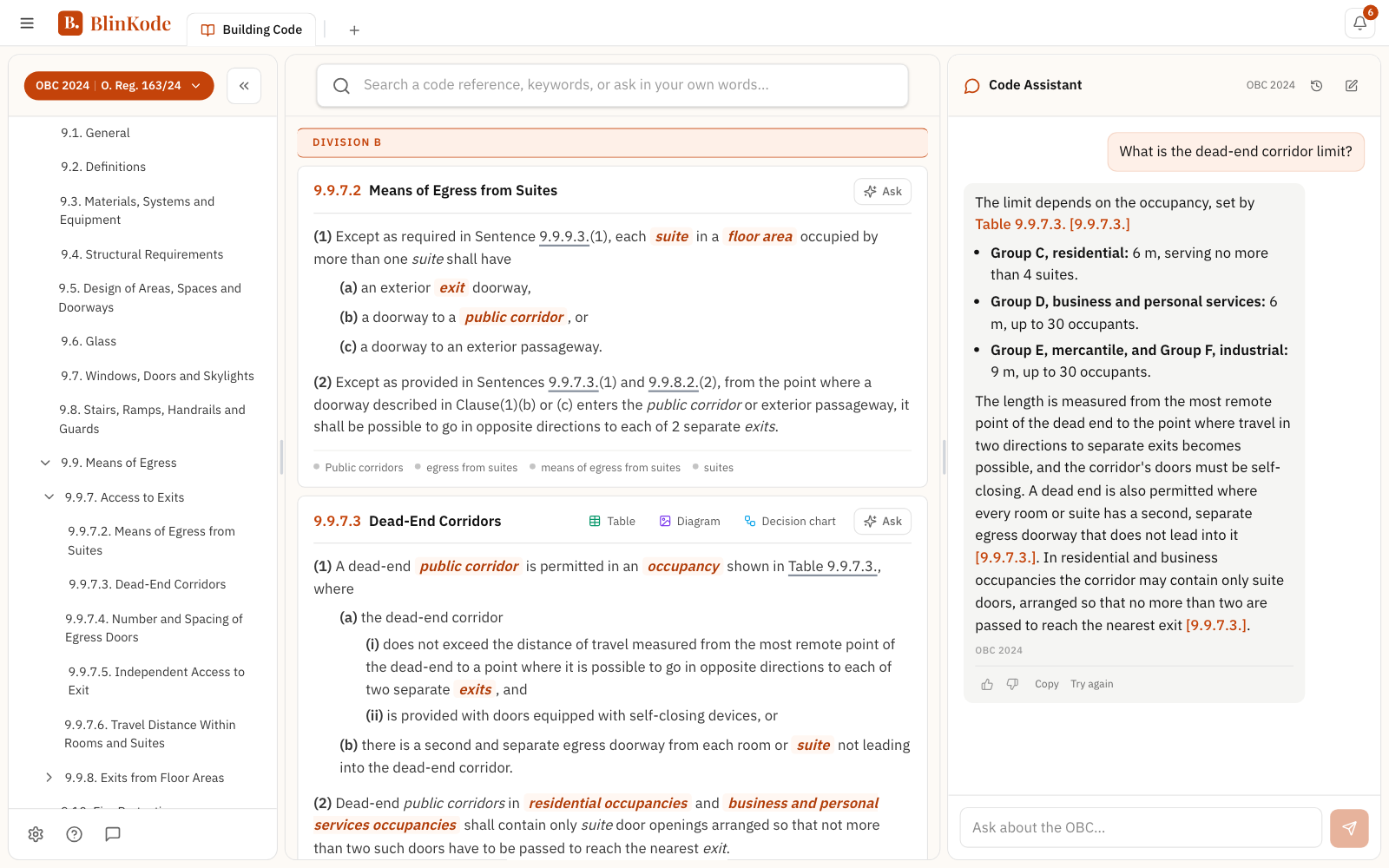
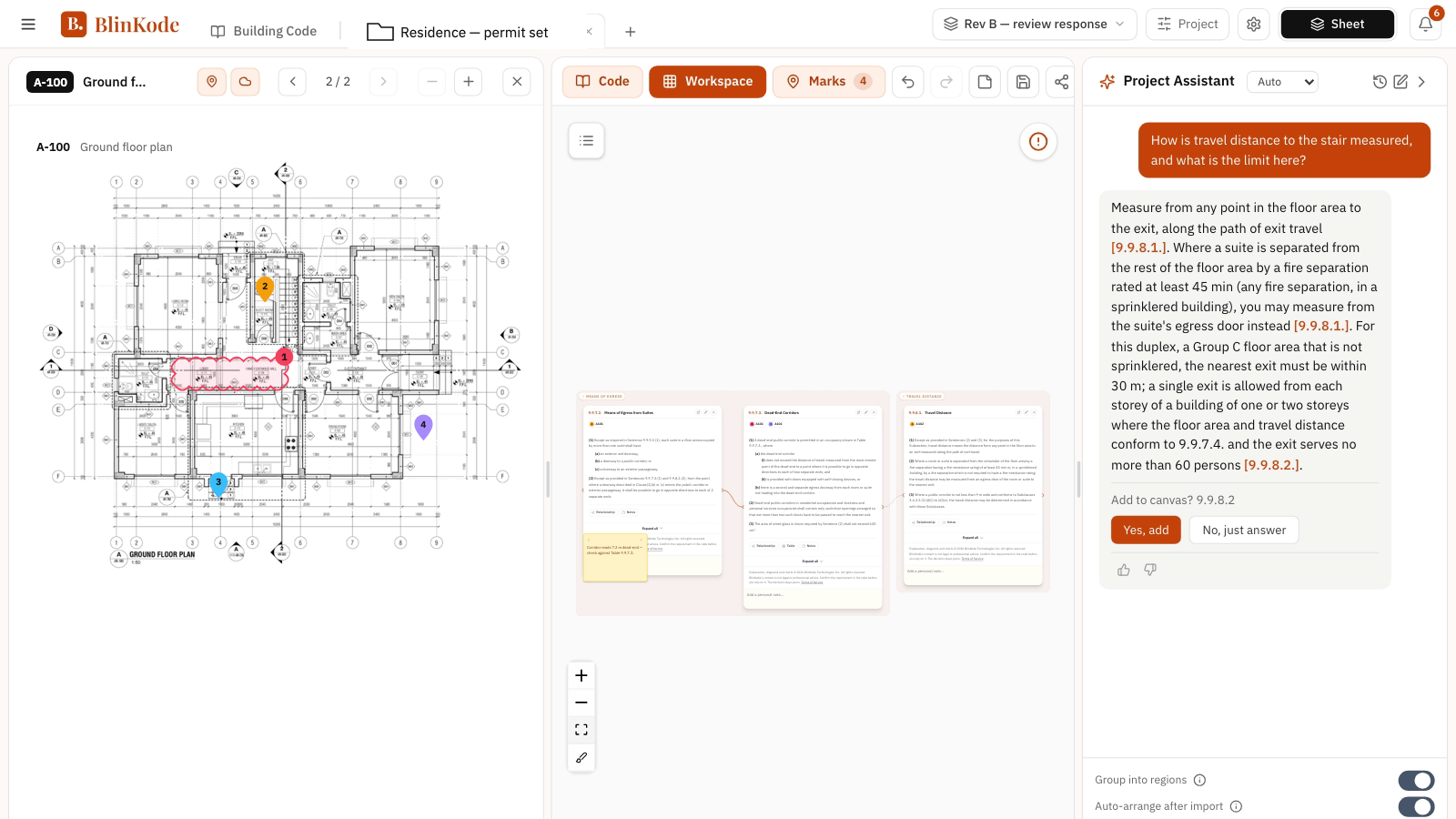
The app: the code as a tree, the search bar, the articles in one scroll, and the Code Assistant answering with clause links.A project: the drawings with their marks, the Board of Code Cards, and the Project Assistant answering about the project.1
1The whole book, as a treeDivision, Part, Section and Article, in the edition you choose. Switch the edition, and the rest of the app switches with it.
2One search, in your own wordsA code reference, a keyword or a question, in one search bar. The article you meant comes first.
3The whole code, in one scrollRead on from article to article, with defined terms marked. Open an article’s Code Card from its table, diagram or decision chart.
4The Code AssistantAsk in your own words. The answer comes straight from the code, with clickable clause links.
5The drawings, markedYour project’s sheets. Pin a point or cloud an area, then drag an article onto the mark to tie it to that spot.
6The BoardThe project’s articles as Code Cards on its Board, grouped by topic and connected by the references between them.
7Project AssistantBrings the articles the project needs onto the Board, answers from them, and asks before it assumes.
8Every issue, keptEach issue of the drawings keeps its own sheets and marks. Switch to an earlier one, or add the next.

Why BlinKode

Checking is part of the work

Even the most experienced people behind a building permit go back to the code on every project. What every check should bring back is the requirement, what it means for this project and its source.

Find the right article
One search bar across the whole code: exact code reference, keyword, or a question in your own words. Results rank the clause you meant, not just the words you typed.
Read what it means
BlinKode’s explanation sits beside the article’s own text, never instead of it, and cites the article.
See it as a diagram
Diagrams and animations translate spatial and system-level requirements into something you can check against a drawing.
Follow the conditions
A decision chart lays out the conditions, exceptions, and dependencies in order, so you can see which path your project actually falls under.
Move across references
An interactive relationship chart maps inbound and outbound references. Every box is clickable: the linked clause opens in place, no scrolling back through the book.
Keep the citation
Every card traces back to the code article it came from, in the edition you selected, so what you document is defensible.

Coverage

The building code, edition by edition

Choose an edition, and the contents, search, Code Cards and Code Assistant all follow it.

Every edition is addressed separately, so a card always says which book it came from. BlinKode is built for the codes across Canada, one at a time.

The Code Card

One article, one card

BlinKode turns a code article into a structured Code Card, with the curated explanations and diagrams added as they are written. Everything on a card traces back to the article it came from.

What’s on a card
Original code text
Verbatim, in the edition you selected
Explanation
In plain words that keep the article’s exact meaning, citing the code
Diagrams & animations
A gallery with a main image and thumbnail strip, where a visual helps
Decision chart
The article’s conditions, exceptions and outcomes, branch by branch
Tables
Where present in the source article or explicitly referenced by it
Relationship chart
Inbound and outbound references as a clickable map: every box opens that clause in place
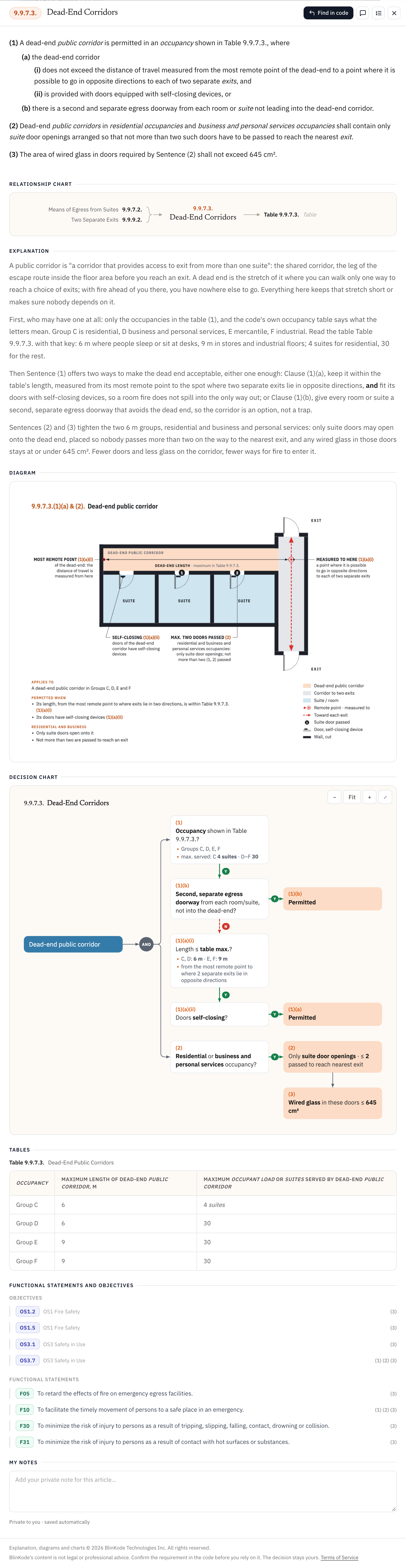
A full Code Card, Dead-End Corridors, OBC Div. B Article 9.9.7.3, showing the original code text, relationship chart, explanation, diagram, decision chart and table.hover to pause

A real Code Card: Dead-End Corridors, OBC Div. B, Article 9.9.7.3.

Project Workspace

Somewhere to put the code you’re actually working with

Each project on its Board, with its edition, drawings and notes: organize the articles that matter, mark the sheets, and connect them.

Cards on a board
Drag any Code Card out of the code onto the Board and group them by topic, one Board per project.
Wired to each other
Connect cards yourself, or add an article from a card’s relationship chart and it arrives already connected.
Pinned to the drawing
Upload a sheet and pin a card or a note to the exact spot it governs. Highlights and notes stay attached to the code.
Project Assistant
In beta. It brings the articles the project needs onto the Board, answers from them, and asks before it assumes.

Free tools

Calculators and Permit Library

Two free parts of BlinKode, beside Code Workspace.

Calculators
Enter a project’s facts once, and the calculators work out what the code requires, every step shown with the article it comes from.

Use Calculators

Permit Library
Permit guides and documents from each municipality’s own pages, checked by our team, dated and linked to the source: whether a permit is needed, the fee, what you submit, and what comes after approval.

Use Permit Library

Built on trust

Guidance you can stand behind

Every requirement comes with its source, so it can be verified in the code itself.

Every requirement with its source
Every Code Card links back to the article it came from, in the edition you selected.
The decision stays yours
BlinKode does not decide. The people who do this work do.
Approval stays with the building official
BlinKode does not approve anything. That stays with the building official. BlinKode is not legal advice.
The original text is there
The explanation sits beside the code text, never instead of it, so you can check it against the article.

BlinKode does not guarantee compliance or a permit. BlinKode does not run on its own. What it brings is read by a professional before anything is drawn, submitted or approved.

Bring your next project into Code Workspace.

The whole book, with Code Cards, Code Assistant, Project Workspace and Project Assistant.

Need to review the design against the code? Explore Drawing Review.

30 days. No card needed.